Instagram marketing for small business has changed more in the last two years than in the previous five combined. The platform looks different. The algorithm behaves differently. And the gap between businesses that are growing on Instagram and those that are spinning their wheels has never been wider.
If you have an Instagram account for your business — and you're posting regularly but not seeing real results — this guide is for you. Not theory. Not vanity metrics. A practical, honest breakdown of what Instagram marketing actually looks like when it's done with intention.
Why Most Small Businesses Get Instagram Wrong
Before we talk about what works, it's worth being honest about why most businesses don't see results from Instagram.
They post without a strategy. They upload a product photo on Monday, a quote graphic on Wednesday, and a team photo on Friday — and wonder why engagement is flat and followers aren't converting. Consistency without direction isn't a strategy. It's just noise.
They chase followers instead of buyers. A following of 50,000 disengaged accounts is worth less than a following of 2,000 people who trust you, engage with your content, and buy from you. Follower count is a vanity metric. Revenue is a business metric.
They treat Instagram as a broadcasting tool. They talk at their audience rather than with them. They post and disappear. They never reply to comments, never engage with other accounts, never create content that invites conversation.
And the biggest mistake of all — they don't have a clear path from Instagram to revenue. No link in bio strategy. No lead capture. No follow-up system. People see the content, enjoy it, and forget about the business entirely within 24 hours.
Instagram marketing for small business only works when there's a real system behind it. The rest of this guide is about building that system.
Step 1: Get Your Profile Working As Hard As Your Content
Before you post another piece of content, your profile needs to be optimised. Most small business Instagram profiles are missing basic elements that cost them followers and customers every single day.
Your profile photo should be clear, recognisable, and consistent with every other platform your business appears on. For most businesses, this means a clean logo on a solid background. For personal brands or solo founders, a high-quality headshot beats a logo every time.
Your name field is searchable. Most businesses use it just for their business name — which is fine — but you can add a keyword after it. "Taskscriber | Growth & Automation" surfaces in searches beyond just your brand name.
Your bio has 150 characters to answer three questions: what you do, who you do it for, and what someone should do next. Most business bios waste this space on slogans that sound good but say nothing. Be specific. "We build websites, CRMs, and email automation for growing e-commerce brands" tells a potential follower exactly whether this account is for them.
Your link in bio is the bridge between Instagram and your actual business. A single link to your homepage is a missed opportunity. Use a link page — whether that's a dedicated landing page, a link tree, or a tool built into your website — that directs followers to your most important destinations: your services, your latest offer, your case studies, your lead magnet.
Story Highlights are permanent and visible above your feed. Use them strategically: one for testimonials, one for your services, one for FAQs, one for recent results. A visitor who lands on your profile should be able to understand your business completely without scrolling down to your feed at all.
Step 2: Build a Content Strategy That Has a Purpose
Instagram marketing for small business doesn't require you to post every day. It requires you to post with intention. There's a significant difference.
The businesses that grow consistently on Instagram use a simple content framework built around three types of posts:
Value content (40% of posts) teaches, informs, or entertains your audience without asking for anything in return. Tips, tutorials, industry insights, behind-the-scenes process content. This is the content that gets saved and shared — and saves and shares are the strongest signals you can send to the Instagram algorithm in 2026.
Proof content (30% of posts) demonstrates results, builds credibility, and reduces the hesitation a potential customer feels before reaching out. Client testimonials, before-and-after results, case study snippets, data-backed outcomes, screenshots of reviews. You don't need to brag — you just need to show evidence that you do what you say you do.
Connection content (30% of posts) is where the relationship with your audience deepens. Your story. Your opinion on something in your industry. A mistake you made and what you learned. A behind-the-scenes look at how you work. This content builds the kind of trust that turns followers into buyers — because people buy from businesses they feel they know.
The most important rule: every piece of content should have a clear purpose. Not "get more likes." A purpose. Educate. Build trust. Generate saves. Drive profile visits. Prompt DMs. Lead people to the link in bio. When you know what you want a post to do, you write it differently — and it performs differently.
Step 3: Master Reels Without Burning Out
Reels are currently Instagram's highest-reach format. A Reel from a small account with 800 followers can reach 80,000 people. That organic reach is something no other content format on the platform offers consistently.
But here's the reality that most social media advice skips: you don't need to post Reels every day to benefit from them. Two to three high-quality Reels per week, built around topics your target audience is actively searching for, will outperform seven rushed Reels that were made just to fill a posting schedule.
What makes a Reel actually perform:
The first second is everything. Instagram users scroll fast. If the opening frame of your Reel doesn't create enough curiosity or interest to stop the thumb, nothing else matters. Text hooks work. Unexpected visuals work. Direct statements that call out your specific audience work. "If you run an e-commerce store and your email list isn't generating revenue — watch this." That hook stops the right person and filters out the wrong one.
Keep it focused. The best performing Reels for small businesses are not cinematic productions. They are clear, useful, and specific. One idea. One point. Delivered confidently and directly.
Use captions. A significant portion of Instagram video is watched without sound — especially during the hours people scroll at work or in public. If your Reel only makes sense with audio, you're losing a large part of your potential audience.
End with a direction. What do you want the viewer to do next? Save the video. Comment with a word. Visit the link in bio. Send a DM. Without a clear next step, the viewer watches and scrolls on — and the engagement that would have signalled to the algorithm that your content is worth pushing gets lost.
Step 4: Use Instagram Stories to Convert Followers Into Leads
Stories are where sales happen on Instagram. Not because people buy directly through Stories — though that does happen — but because Stories are where the relationship becomes real.
Feed posts introduce you. Stories remind people you exist every single day.
The businesses that generate consistent leads through Instagram post to their Stories daily — not elaborate productions, just short, human touchpoints. A question sticker that invites replies. A poll about something relevant to your audience. A behind-the-scenes clip of work in progress. A "last 24 hours" reminder about an offer. A client win, casually shared.
Stories that generate DMs are especially valuable. A DM is a private conversation — and private conversations convert at dramatically higher rates than public posts. When someone slides into your DMs to ask about your service, they are a warm lead. They chose to reach out. The hard part is already done.
A few Story formats that consistently drive DMs for small businesses:
- "Drop a 🙋 in my DMs if you want me to share how we did this for a client"
- "Honest question — what's the #1 thing holding your [business/store/marketing] back right now?"
- "We just finished a project for a [client type]. Want to see the results?" with a "Yes!" reply sticker
None of these are pushy. All of them open conversations. And conversations become clients.
Step 5: Hashtags, SEO, and How People Actually Find You in 2026
The role of hashtags on Instagram has shifted considerably. They are no longer the primary discovery mechanism they once were — Instagram's own data suggests that keyword-based search and the Explore page algorithm now drive far more discovery than hashtag following.
This doesn't mean hashtags are useless. It means they should be used strategically rather than stuffed.
For small businesses, the most effective approach is a mix of three hashtag types: niche-specific tags with moderate volume (under 500K posts) where your content can actually be seen, audience-specific tags that describe who your ideal follower is, and location-based tags if your business has a local or regional element.
Far more important than hashtags in 2026 is Instagram SEO — the practice of using relevant keywords in your captions, your profile name, your bio, and your alt text so that Instagram's search function surfaces your content to people who are actively looking for it.
When someone types "email marketing for small business" into Instagram search, accounts and posts that use that phrase naturally in their content are more likely to appear. This is a relatively underused advantage for small businesses — and one that compounds over time as your content library grows.
Write captions like a human who also understands what their audience is searching for. Lead with the most important sentence. Include the keyword naturally. Tell a story, make a point, or share a result. Then close with a CTA and your hashtags.
Step 6: Turn Instagram Followers Into Email Subscribers
Here's the hard truth about Instagram that most small business owners learn the painful way: you don't own your Instagram audience.
If Instagram changes its algorithm tomorrow — which it does, regularly — your reach can drop overnight. If your account gets flagged or restricted — which happens to legitimate businesses more often than you'd think — you lose access to an audience you spent years building.
Your email list is an asset you own completely. Instagram's job, in a fully built marketing system, is to feed that list.
The path from Instagram follower to email subscriber requires three things: a reason to give you their email (a lead magnet — a free guide, a checklist, a template, a discount), a frictionless way to opt in (a landing page linked from your bio), and a welcome sequence that immediately delivers value and builds on the trust they developed through your Instagram content.
When this system is in place, Instagram becomes a top-of-funnel channel that feeds a bottom-of-funnel email system. The Instagram content builds awareness and trust. The email system converts that trust into revenue. Each channel makes the other more valuable.
Without this connection, Instagram is just a platform you're performing on — with no reliable way to capture or monetise the attention you're earning.
Step 7: Instagram for E-Commerce — Turning the Platform Into a Sales Channel
For e-commerce businesses specifically, Instagram offers capabilities that go well beyond brand awareness.
Instagram Shopping allows you to tag products directly in your posts, Reels, and Stories — so a viewer can go from seeing a product in context to viewing its price and details in two taps. If you're selling physical products and you haven't set up Instagram Shopping, you are leaving money on the table with every post.
The Shop tab on your profile gives followers a dedicated space to browse your products without leaving Instagram. Combined with product tags in content, this creates a native shopping experience that reduces friction significantly.
Shoppable Reels combine the reach of video content with direct product discovery. A Reel that showcases a product in use, with shoppable tags, can generate sales from viewers who had no prior awareness of your brand.
The key for e-commerce businesses is connecting the Instagram Shopping catalogue to a proper retargeting and email system. Someone who clicks a product tag but doesn't purchase is a warm lead — they've shown specific product intent. Without a follow-up system, that intent disappears. With one, it becomes a conversion opportunity.
Step 8: The Posting Schedule That Actually Works
One of the most common questions in Instagram marketing for small business is: how often should I post?
The answer that social media gurus give — "as often as possible" or "at least once a day" — is wrong for most small businesses. Posting frequency without quality is a fast path to audience fatigue and content that performs worse over time.
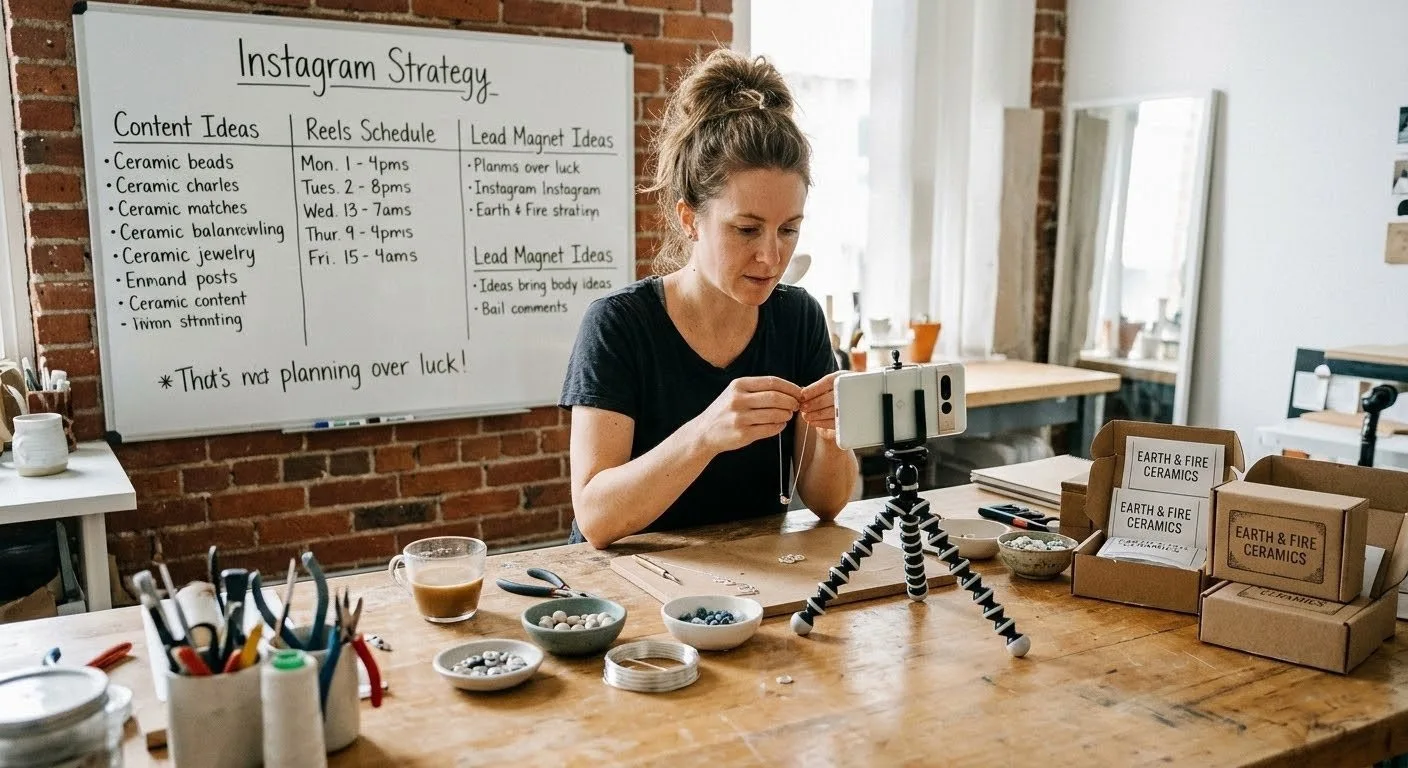
A realistic, sustainable schedule for a small business with limited content resources:
- Reels: 2–3 per week
- Feed posts (carousels or single images): 2–3 per week
- Stories: Daily (these take minutes, not hours)
That's it. Eight to ten pieces of content per week sounds like a lot — but when you break it down, it's two Reels, two carousels, and a Story each day. And Stories can be as simple as a photo of your workspace with a question sticker.
Consistency over volume. The accounts that grow steadily on Instagram are the ones that show up reliably — not the ones that post frantically for two weeks and then disappear for a month.
Use a content calendar. Plan your posts a week ahead. Batch your Reels on one day. Schedule your feed posts in advance. The businesses that treat content creation as a system rather than a daily scramble produce better content, more consistently, with less stress.
What Instagram Marketing for Small Business Actually Requires
There's a version of Instagram success that looks effortless from the outside — beautiful content, engaged followers, steady leads coming in. What you don't see is the system behind it.
A content strategy that defines what gets posted and why. A posting schedule that's realistic and sustainable. A profile optimised to convert visitors into followers and followers into leads. A link in bio connected to a real lead capture system. An email welcome sequence that picks up where Instagram leaves off. A retargeting setup that re-engages warm visitors who didn't convert.
This is what Instagram marketing for small business looks like when it's treated as a growth channel rather than a content obligation.
Some businesses build this themselves over months of trial and error. Others bring in a team who has already built these systems — for e-commerce brands, service businesses, local companies, and SaaS startups — and can have the whole thing running in weeks.
Either way, the goal is the same: an Instagram presence that doesn't just look good, but consistently brings real people into your world and gives them a reason to stay.