You already know email marketing works.
You've heard the stats. You've read the case studies. You've probably even signed up for a few newsletters that you thought — "I should be doing this."
And yet, for most small and mid-sized businesses, the email list sits there. Growing slowly, getting blasted with promotions every now and then, and never really doing what everyone said it would do.
The problem isn't email. Email still delivers the highest ROI of any digital marketing channel — $36 back for every $1 spent, consistently, year after year.
The problem is the approach.
Most businesses treat email like a megaphone. Something you pick up when you want to announce a sale, launch a product, or fill a slow week. But the businesses that actually make serious money from email treat it like a conversation. A relationship. A system that runs quietly in the background — welcoming, nurturing, following up, and recovering — while the team focuses on everything else.
This post is about building that system. Not theory. Not a vague strategy. The actual mechanics of what email marketing looks like when it's done right — and what it costs you when it isn't.
The Expensive Mistake Almost Every Business Makes
Here's a situation that's more common than most business owners want to admit.
You've got a list. Maybe it's 2,000 subscribers. Maybe it's 10,000. You built it over months or years — through your website opt-in form, past customers, lead magnets, events. People actively chose to hear from you. That's not nothing. That's actually remarkable.
And then... you send them a promotional email when you need a sales boost. You go quiet for six weeks. You send another one. Open rates are mediocre. Revenue from email is an afterthought. You tell yourself you'll "sort out the email strategy" when things slow down.
Things never slow down.
Meanwhile, you're spending money — often significant money — on paid ads to reach cold audiences who have never heard of you and have no particular reason to trust you yet. You're doing the hard work of acquisition while ignoring the warm audience you already have.
This is the most expensive mistake in digital marketing. Not a dramatic mistake. Not an obvious one. Just a slow, quiet, continuous leak — missed revenue that never shows up on a report because it was never counted.
Email done properly doesn't just generate revenue. It reduces what you spend on acquisition. It improves customer lifetime value. It turns one-time buyers into loyal ones. And unlike social media, where your reach depends on an algorithm you don't control, your email list is an asset you own completely.
So why isn't everyone doing it properly?
Because building an email system that actually works takes more than writing a few emails, it takes structure. And most businesses — understandably — don't know where to start.
What "Email Marketing" Actually Means in 2026
There's a version of email marketing that most people are familiar with: the monthly newsletter. The promotional blast. The "just checking in" message that nobody asked for.
That's not what we're talking about here.
Modern email marketing has two distinct components, and understanding the difference between them is the foundation of everything else.
Campaigns are the emails you deliberately choose to send. New product announcements. Seasonal promotions. Educational content. These are planned, scheduled, and sent to a segment or your full list. They're intentional and time-sensitive.
Automations (also called flows or sequences) are emails that send themselves — triggered by a subscriber's behaviour. Someone signs up: a welcome sequence starts. Someone leaves items in their cart: a recovery sequence kicks in. Someone makes a purchase: a post-purchase sequence begins. No manual action required. These emails run continuously in the background, day and night, based on what your subscribers actually do.
The businesses that treat email as a revenue engine use both — but they prioritize automations first. Because automations are where the compounding happens, you build them once. You refine them over time. And they keep generating returns indefinitely.
--------------------------------------------------------------------------------------------------------------
The 5 Email Automations Every Business Needs
If you build nothing else, build these five. They cover every critical moment in the customer journey — from the second someone joins your list to the moment they've gone quiet for too long.
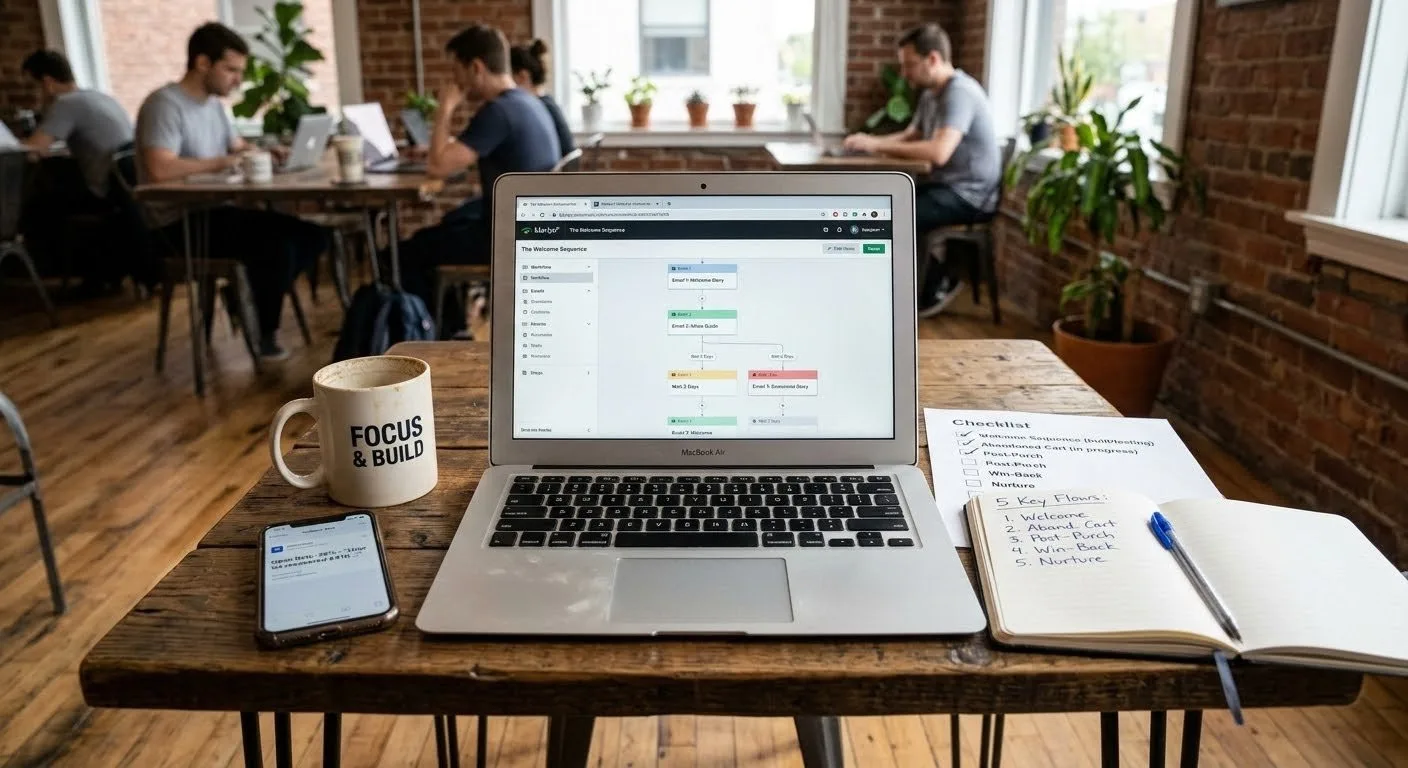
1. The Welcome Sequence
This is the most important email sequence you will ever write. And it's the one most businesses either skip entirely or get badly wrong.
When someone joins your list, they are at peak interest. They just took an action — submitted a form, opted in, made a purchase. Whatever the reason, they're thinking about you right now. That window doesn't stay open indefinitely.
A welcome sequence is 4–6 emails, sent over the first 7–10 days, that do one thing above everything else: make the subscriber feel like joining your list was a good decision.
Not a sales pitch. Not a discount. A welcome sequence earns trust before it asks for anything.
Here's what a strong welcome sequence looks like:
- Email 1 (Immediate): Deliver whatever you promised — lead magnet, discount code, resource. Introduce yourself briefly, warmly, like a person, not a brand.
- Email 2 (Day 2): Share your story. Why does your business exist? What do you believe that your competitors don't? This email should feel personal.
- Email 3 (Day 4): Provide genuine value. A guide, a tip, a framework. Something useful regardless of whether they ever buy from you.
- Email 4 (Day 6): Social proof. A customer story, a result, a testimonial. Not hyperbolic. Real.
- Email 5 (Day 9): A soft, natural offer. Not "BUY NOW." More like — "If you've been thinking about X, here's where to start."
Businesses that send no welcome sequence typically convert 2–4% of new subscribers into buyers within the first 30 days. Businesses with a well-built welcome sequence routinely hit 15–22%. The sequence takes a few hours to build and runs forever.
2. The Abandoned Cart Sequence
This one is specifically for e-commerce businesses, but the principle applies to anyone with a form, booking flow, or checkout process.
Somewhere between 70–80% of people who add items to a cart never complete the purchase. That number is staggering. For every 10 people who get close to buying, 7 or 8 just... leave.
Some of them got distracted. Some of them had a question that wasn't answered. Some of them weren't quite ready. Very few of them actively decided they didn't want the product.
An abandoned cart sequence brings them back. Three emails, spaced deliberately:
- Email 1 (1 hour after abandonment): Gentle, assumptive. "You left something behind." No pressure. Link directly back to their cart.
- Email 2 (24 hours later): More substantive. Remind them what they were looking at. Address the most common objections — quality, returns, sizing. Include a review or two.
- Email 3 (48–72 hours later): A final nudge, often with a small incentive. Free shipping, a modest discount, a time-sensitive offer.
A well-structured abandoned cart sequence recovers between 20–30% of abandoned sessions. For a business doing any volume at all, this is one of the highest-return automations that exists. The revenue it generates is money that was already being lost — you're simply stopping the leak.
3. The Post-Purchase Sequence
Most businesses treat the sale as the finish line. It isn't. It's the starting line.
A customer who just bought from you is at their highest moment of trust and satisfaction. They chose you over alternatives. They spent money. They're paying attention. This is precisely the wrong moment to go silent.
A post-purchase sequence does four things: it confirms and celebrates the purchase (making the buyer feel good about their decision), it helps them get maximum value from what they bought (reducing buyer's remorse and returns), it introduces complementary products naturally (increasing average order value), and it invites them back before the memory of the first purchase fades.
Here's how to structure it:
- Email 1 (Immediate): Order confirmation with warmth. Not just a receipt — a genuine thank you that reflects your brand.
- Email 2 (Day 3): A usage guide, tips, or care instructions. Make them feel supported.
- Email 3 (Day 7–10): "You might also like." A curated recommendation based on what they bought. Presented helpfully, not pushy.
- Email 4 (Day 21–30): A loyalty offer or check-in. "How's everything going?" Plus an incentive to come back.
Businesses with a structured post-purchase sequence see repeat purchase rates 30–40% higher than those without one. Customer lifetime value — the metric that determines the long-term health of any e-commerce business — improves significantly when you treat the first purchase as the beginning of a relationship, not the end of a transaction.
4. The Win-Back Sequence
Every list has them: subscribers who used to engage but have gone quiet. Maybe they bought once and never returned. Maybe they opened emails for a few months and then stopped. Maybe life got in the way.
These are not lost causes. They're warm leads who need a reason to re-engage.
A win-back sequence is a short, direct, slightly personal campaign designed to reignite interest — or, if that fails, to cleanly remove unresponsive subscribers so they don't continue to damage your deliverability.
- Email 1: "We've missed you." Acknowledge the silence. Share something new — a product, a result, something worth coming back for.
- Email 2: A genuine offer. Not your standard discount — something that feels like it was made for them. Exclusive, time-limited.
- Email 3: The honest goodbye. "If we're not a fit anymore, no hard feelings — but we'd hate for you to miss what's coming." This email often outperforms the others in re-engagement rate purely because of how direct it is.
Typically, a win-back sequence reactivates 15–25% of dormant subscribers. Those who re-engage tend to become among the most loyal customers going forward. Those who don't get cleaned from the list — which improves overall deliverability and makes every other email perform better.
5. The Lead Nurture Sequence
Not everyone is ready to buy the moment they find you. Especially for higher-ticket products, services, or B2B offers, the decision can take weeks or months.
A lead nurture sequence keeps you present during that decision-making period — educating, building trust, addressing concerns — so that when the prospect is finally ready, you're the obvious choice.
The mistake most businesses make here is going quiet between initial contact and follow-up. The prospect forgets about them. A competitor sends something useful. The sale goes elsewhere.
A nurture sequence prevents that. It runs on a longer cadence — one or two emails per week for 4–8 weeks — and focuses almost entirely on value rather than promotion.
What does value look like in a nurture sequence?
- Case studies relevant to the subscriber's situation
- Frameworks and practical guides they can apply immediately
- FAQs or objection responses, written conversationally
- Behind-the-scenes content that builds trust in your team and process
- Social proof that speaks to their specific context
The ratio to aim for: 80% value, 20% offer. By the time the sequence ends with a clear CTA, the subscriber has received enough to trust you — and has been given every opportunity to raise their hand when they're ready.
--------------------------------------------------------------------------------------------------------------
The Campaign Layer: Staying Top of Mind Between Automations
Automations are the backbone. Campaigns are the ongoing conversation.
Once your flows are built, you should be sending regular email campaigns on a consistent schedule. Not every email needs to be a promotion. In fact, the businesses with the highest engagement send more value emails than promotional ones — typically in a 3:1 or 2:1 ratio.
Here's a simple weekly structure that works:
Monday or Tuesday: A value email. A tip, a guide, a story from a client. Something useful that your subscribers can apply whether they ever buy from you or not. This builds trust over time in a way that promotions never can.
Thursday or Friday: A commercial email. A product feature, a promotion, a new service. Because you've been delivering value consistently, this doesn't feel like a sales pitch. It feels like a natural part of the conversation.
Subject lines matter enormously. The average open rate across industries is around 21%. Businesses that write strong subject lines — specific, intriguing, personal — consistently hit 35–45%. A subject line is a door. If nobody opens it, nothing inside matters.
A few principles:
- Specific beats vague. "How we recovered $41K in frozen eBay payouts" outperforms "Our latest case study."
- Personal beats corporate. "I made this mistake last week" outperforms "Important update from the team."
- Curiosity beats completeness. Leave a gap. Don't summarise the email in the subject line.
Why Deliverability Is the Silent Killer
You can have the best emails ever written and still have them land in spam. Deliverability — whether your emails actually reach the inbox — is a technical and behavioural factor that most businesses never think about until it's already a problem.
A few things that damage deliverability over time:
Sending to unengaged subscribers. If a significant portion of your list never opens your emails, inbox providers start treating your emails as unwanted. The engaged subscribers suffer because of the unengaged ones.
Sending inconsistently. Going quiet for two months and then blasting a promotional campaign confuses inbox providers and subscribers alike.
Poor email hygiene. Bounced emails, spam complaints, and unsubscribes that aren't processed properly all hurt your sender reputation.
Low engagement rates. Open rates, click rates, and reply rates are signals. Inbox providers pay attention to them.
The solution is a combination of regular list cleaning, consistent sending cadence, strong subject lines that drive opens, and removing unresponsive subscribers through win-back campaigns before they accumulate.
A clean, engaged list of 3,000 subscribers will consistently outperform a neglected list of 15,000. Size is not the metric. Engagement is.
Segmentation: Talking to the Right People, Not Everyone at Once
One of the fastest ways to improve email performance is to stop treating all subscribers the same.
A new subscriber who has never purchased deserves a different email than a loyal customer who has bought four times. A subscriber who clicked on a specific product page is signalling intent that a subscriber who only reads your newsletters hasn't shown yet.
Segmentation is the practice of grouping your subscribers by behaviour, purchase history, lifecycle stage, or interest — and sending them content that's actually relevant to where they are.
Even basic segmentation produces meaningful results. Segmented campaigns generate 14% higher open rates and 100% higher click rates than non-segmented ones, according to industry benchmarks. More advanced segmentation — triggered by specific actions, purchase behaviour, or engagement level — compounds these gains further.
At minimum, every business should be segmenting by:
- New subscribers (under 30 days, no purchase)
- Active customers (purchased within 90 days)
- Lapsed customers (purchased but inactive for 90+ days)
- High-value customers (multiple purchases or above a spend threshold)
- Engaged non-buyers (regular openers who haven't converted)
Each of these groups gets different messaging, different offers, and a different tone. The result is emails that feel personal — because they're actually relevant to the person reading them.