Etsy SEO for Sellers: The Complete Growth Guide for New Shops
Etsy SEO for sellers is the single most important factor that determines whether your shop gets discovered or disappears into the platform's 100 million active listings.
You can have the most beautiful products on the platform. You can have competitive pricing, stunning photography, and five-star customer service. But if your listings are not optimized for Etsy search, none of that matters — because buyers will never find you in the first place.
The good news is that most new sellers do not optimize their listings properly. That is not a criticism. Nobody teaches you how Etsy search actually works when you open a shop. Most sellers guess, copy what others are doing, and hope for the best.
This guide removes the guesswork. By the end, you will understand exactly how Etsy's search algorithm works, how to research the right keywords, how to structure your listings for maximum visibility, and how to build a shop that grows consistently over time.
How Etsy Search Actually Works
Before you can optimize for Etsy SEO, you need to understand what Etsy is trying to do when someone types a search query.
Etsy's goal is simple: show buyers the listings most likely to result in a purchase. That means the algorithm is looking for two things simultaneously — relevance and quality.
Relevance is about matching your listing to what the buyer searched for. Etsy scans your title, tags, categories, and listing description to determine how closely your product matches the search query.
Quality is about how well your listing converts. Etsy tracks click-through rate, conversion rate, reviews, recency, and shipping speed to determine which listings from a relevant pool deserve to rank highest.
This is an important distinction. Two listings can be equally relevant for the same keyword, but the one with better conversion signals — more sales, better reviews, stronger photos that generate clicks — will consistently outrank the other.
That means Etsy SEO for sellers is not just about keywords. It is about building listings that both rank and convert. The two goals have to work together.
Step 1: Keyword Research for Etsy Sellers
Everything in Etsy SEO starts with understanding what your buyers are actually searching for. Not what you think they are searching for — what they are literally typing into the search bar.
These two things are often very different.
A seller making handmade ceramic mugs might describe their product as "wheel-thrown stoneware with reactive glaze." A buyer looking to purchase that exact mug is typing "unique coffee mug handmade" or "ceramic mug gift for her."
Your job is to find the gap between how you describe your product and how your buyers search for it — and then close that gap with the right keywords.
Use Etsy's own search bar. Start typing a word related to your product and pay attention to the autocomplete suggestions that appear. These are real searches that real buyers are making right now. They are Etsy's way of telling you exactly what people want. Make a list of every relevant suggestion.
Study your competitors. Search for your main product and look at the top-ranking listings. Read their titles carefully. Look at what phrases they are using repeatedly. These sellers have likely already done keyword research — you can learn from what is already working.
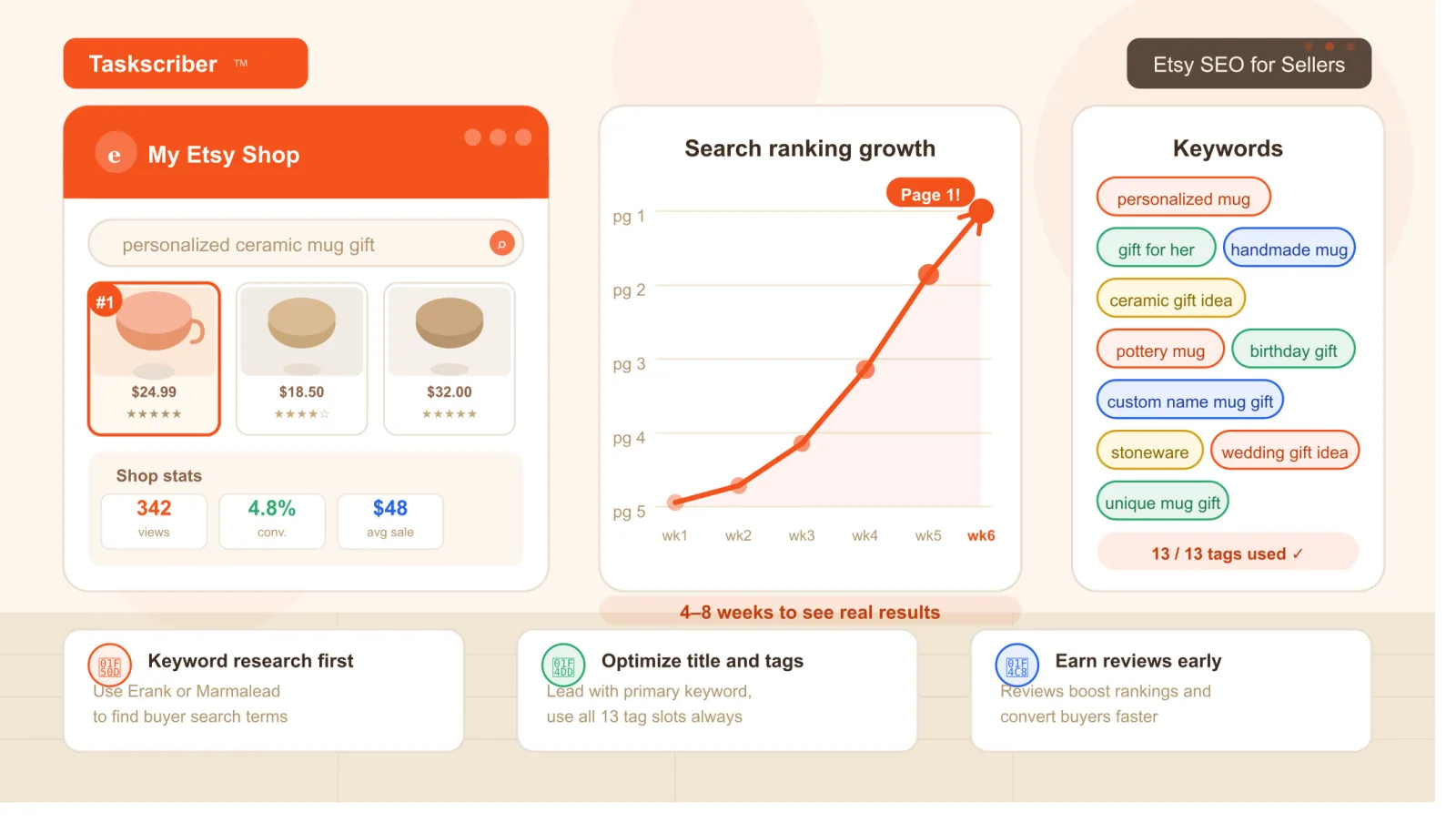
Use keyword research tools. Tools like Erank, Marmalead, and Sale Samurai are built specifically for Etsy keyword research. They show you search volume, competition level, and trending keywords so you can make informed decisions rather than educated guesses. Most offer free tiers sufficient for new sellers.
Target long-tail keywords. A long-tail keyword is a more specific phrase — three to five words rather than one or two. "Personalized wedding gift for couple" is a long-tail keyword. "Gift" is not. Long-tail keywords have lower search volume but much lower competition, which means a new shop has a realistic chance of ranking for them. Build your early SEO strategy around long-tail keywords and expand to broader terms as your shop earns more authority.
Step 2: Writing Etsy Titles That Rank and Convert
Your listing title is the most important place to put your keywords. Etsy gives it the highest weight in its relevance calculation, which means getting your title right is non-negotiable.
Here is what most new sellers do wrong: they write titles for humans instead of for search. They write something like "Beautiful Handmade Ceramic Coffee Mug — Perfect for Your Morning Routine." It sounds nice. It ranks for almost nothing.
A title built for Etsy SEO looks different. It leads with the most important keyword, includes secondary keywords naturally, and still makes sense when a person reads it.
Something like: "Personalized Ceramic Coffee Mug Handmade — Custom Name Mug Gift for Her, Pottery Mug Unique Birthday Gift"
That title contains multiple specific search phrases buyers actually use. It is not poetic, but it gets found — and once a buyer clicks, the photo and description do the emotional selling.
A few practical rules for Etsy titles:
Lead with your most important keyword. Etsy gives slightly more weight to keywords that appear at the beginning of your title. Do not bury your primary keyword in the middle.
Use your full character allowance. Etsy allows up to 140 characters in a title. Use as much of that space as you can with relevant keywords. Every unused character is a missed opportunity.
Do not keyword stuff. Repeating the same word multiple times does not help and makes your listing look spammy to buyers. Use each keyword variation once and move on to the next relevant phrase.
Write for readability too. The title appears in search results and buyers do read it. A title that is pure keyword chaos may rank but will not get clicked. Find the balance between keyword density and human readability.
Step 3: Using Etsy Tags the Right Way
Etsy gives you 13 tags per listing. This is prime real estate and most new sellers waste it by using single broad words like "gift," "handmade," or "cute."
Each tag should be a phrase — ideally two to five words — that represents a specific search query a buyer might use. Think of each tag as a separate opportunity to rank for a different keyword.
Here is how to build a strong tag strategy:
Do not repeat your title keywords in your tags. Etsy already uses your title for relevance matching. Your tags should expand your keyword coverage, not duplicate what is already in your title. Use tags to target variations, related phrases, and alternative search terms.
Use all 13 tags every time. Leaving tags empty is leaving ranking opportunities on the table. Every listing should have all 13 tags filled with specific, relevant phrases.
Think like a buyer. What occasion is this product for? What problem does it solve? Who is it for? What style or aesthetic does it match? These angles often generate strong tag ideas that broader keyword research misses. "Mother's Day gift under 30 dollars" and "boho home decor gift" are both valid tags that come from thinking about buyer intent rather than just product description.
Mix broad and specific tags. Some tags should target higher-volume phrases to capture broad exposure. Others should be highly specific to attract buyers who know exactly what they want. The specific tags will convert better. The broader tags will generate more impressions.
Step 4: Optimizing Your Listing Description for SEO and Conversion
Etsy's algorithm reads your description for relevance signals, though it carries less weight than your title and tags. More importantly, your description is what convinces a buyer who clicked your listing to actually purchase.
Structure your description to accomplish both goals.
Open with your primary keyword naturally. Work your most important keyword into the first sentence of your description. This reinforces relevance for the algorithm and immediately confirms to the buyer that they found what they were looking for.
Answer the questions buyers have before they ask them. Size, materials, colors, personalization options, care instructions, processing time, shipping estimates — anything a buyer needs to know before purchasing should be clearly explained. Unanswered questions lead to abandoned listings.
Write for the buyer's outcome, not just the product's features. Do not just describe what the product is. Describe what the buyer experiences when they have it. Who will they give it to? How will it make that person feel? What problem does it solve in their life? Emotional resonance sells on Etsy.
Include secondary keywords naturally throughout. Work in relevant phrases where they fit naturally. Do not force them in a way that reads awkwardly. A well-written description that happens to include relevant search terms will always outperform a robotic keyword-stuffed one.
Step 5: Product Photography That Improves Your SEO
This might seem unrelated to SEO, but it directly affects your Etsy rankings in a way most new sellers do not realize.
Remember how the algorithm weighs quality signals alongside relevance? Click-through rate — the percentage of people who see your listing in search results and actually click on it — is one of those quality signals.
Your thumbnail image is what drives click-through rate. If your main photo is dark, cluttered, or unclear, buyers will scroll past your listing even when it ranks well. That low click-through rate tells Etsy your listing is not satisfying buyers, and your ranking drops.
Strong product photography for Etsy means:
A clean, clear main image. Your thumbnail should show the product prominently against a simple background. The buyer should understand exactly what they are looking at in under one second.
Natural lighting whenever possible. Natural light shows color and texture accurately and gives photos a warm, appealing quality that artificial lighting rarely matches. If natural light is not available, a basic lightbox produces consistent results.
Multiple photos showing context. Show the product in use, show scale, show detail shots, show different angles. Buyers cannot touch or examine your product in person. Photos are how they build confidence in the purchase.
Lifestyle shots that tell a story. Show the product in the environment where it belongs. A candle on a cozy nightstand. A tote bag being carried at a market. A mug on a wooden table with morning light behind it. Lifestyle images build emotional connection and significantly increase conversion rates.
Step 6: Pricing, Shipping, and Reviews — The Conversion Signals That Affect Rankings
Etsy's algorithm does not just look at your keywords. It looks at your entire listing's ability to convert browsers into buyers. A few factors beyond keyword optimization have a direct impact on where you rank.
Competitive pricing. Etsy surfaces listings that convert well. If your pricing is significantly higher than comparable listings without a clear reason, conversion rate will suffer and rankings will follow. Know what the market rate is for your product category and price accordingly — though never race to the bottom. Position your pricing with your quality.
Offering free shipping. Etsy has explicitly stated that listings offering free shipping to US buyers receive a rankings boost for US search results. If your margins allow it, building shipping costs into your product price and offering free shipping is one of the simplest ranking improvements you can make.
Fast processing times. Listings with shorter processing and shipping times rank better and convert more. Buyers want their purchases quickly. If you can reduce your processing time without sacrificing quality, do it.
Earning reviews early. Reviews are among the strongest trust signals on Etsy and they influence rankings directly. For new shops with no reviews, getting those first few is a priority. Deliver an exceptional product, package it beautifully, include a personal note, and follow up with a thank you message that gently reminds buyers how much a review helps your small shop.
Step 7: Shop Consistency and Activity Signals
Etsy rewards shops that are active and consistent. The algorithm interprets new listings, regular updates, and consistent sales as signals that a shop is healthy and trustworthy.
Add new listings regularly. Shops that add listings consistently tend to get a visibility boost from Etsy, as new listings are shown to a broader audience initially to gauge buyer interest. Even if you have a small product range, consider creating variations as separate listings rather than listing everything as options within a single listing.
Renew listings strategically. When a listing sells or expires and you renew it, Etsy gives it a short burst of fresh visibility. Staggering your renewals rather than doing them all at once spreads that visibility boost over time.
Keep your shop policies complete and professional. Shipping policies, return policies, and FAQs contribute to buyer confidence. Shops with complete policies tend to convert better, and conversion feeds back into rankings.
Stay active on the platform. Logging into your shop, responding to messages quickly, and engaging with the platform consistently all send positive signals to Etsy about your shop's health.
Building a Long-Term Etsy SEO Growth Strategy
Getting your first sales through SEO is the beginning, not the destination. The shops that build sustainable income on Etsy treat SEO as an ongoing process rather than a one-time setup.
Review and update your listings regularly. Search trends shift. Buyer language evolves. Seasonal keywords come and go. Set aside time every month to review your top and bottom performing listings, update keywords based on current search data, and refresh photos or descriptions that are underperforming.
Use Etsy Stats to guide decisions. Etsy provides detailed traffic data showing which keywords bring visitors to your shop, which listings get the most views, and where your traffic comes from. Use this data to double down on what is working and fix what is not.
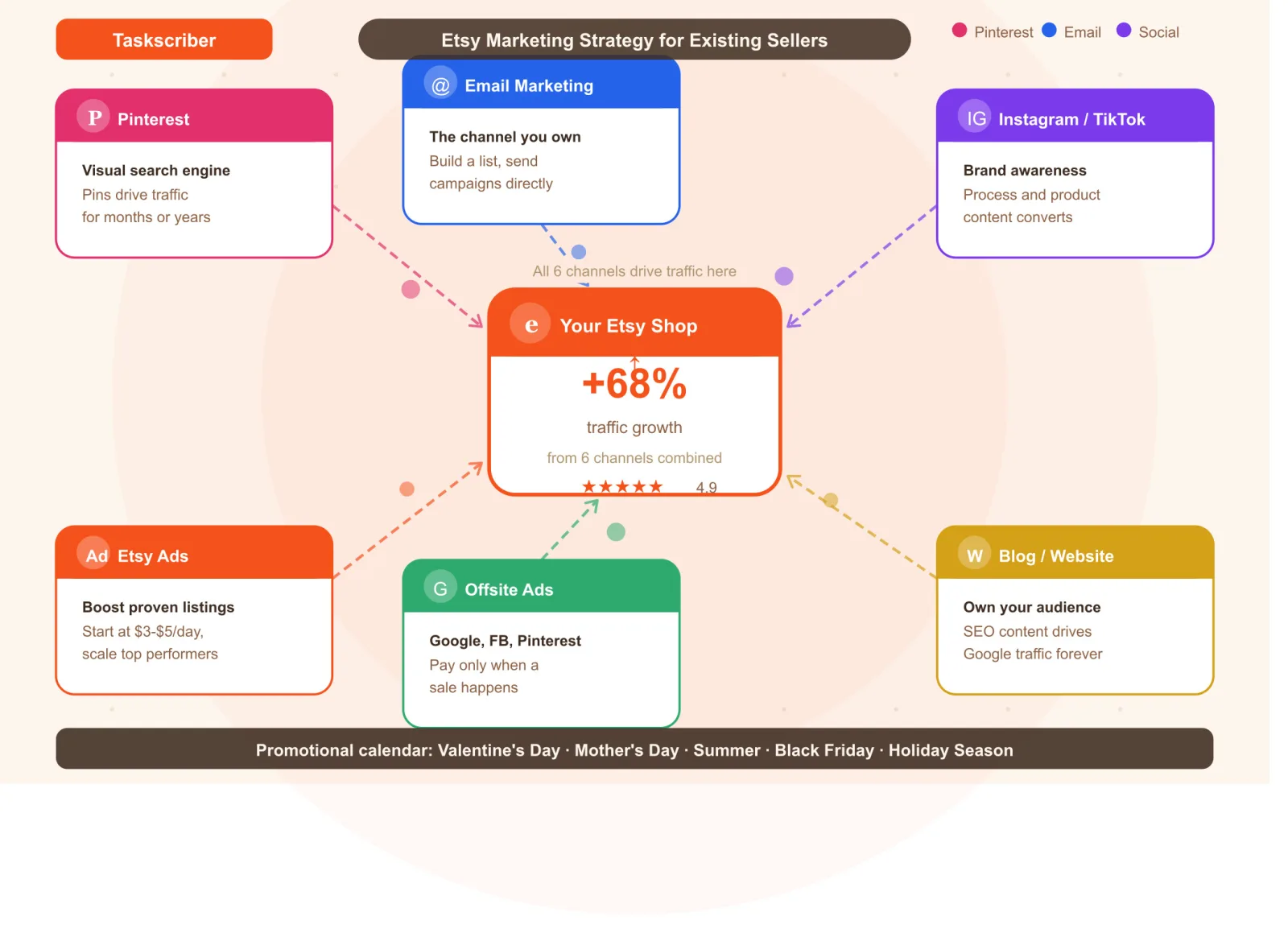
Build outside traffic to support your Etsy SEO. Pinterest, Instagram, and email marketing can all drive external traffic to your Etsy shop. External traffic that converts sends a strong positive signal to Etsy's algorithm and can accelerate your rankings meaningfully.
Expand your product range strategically. More listings mean more keyword coverage and more opportunities to appear in search results. Expanding your range in a focused, coherent way builds shop authority over time and gives you more ranking surface area across different buyer search queries.