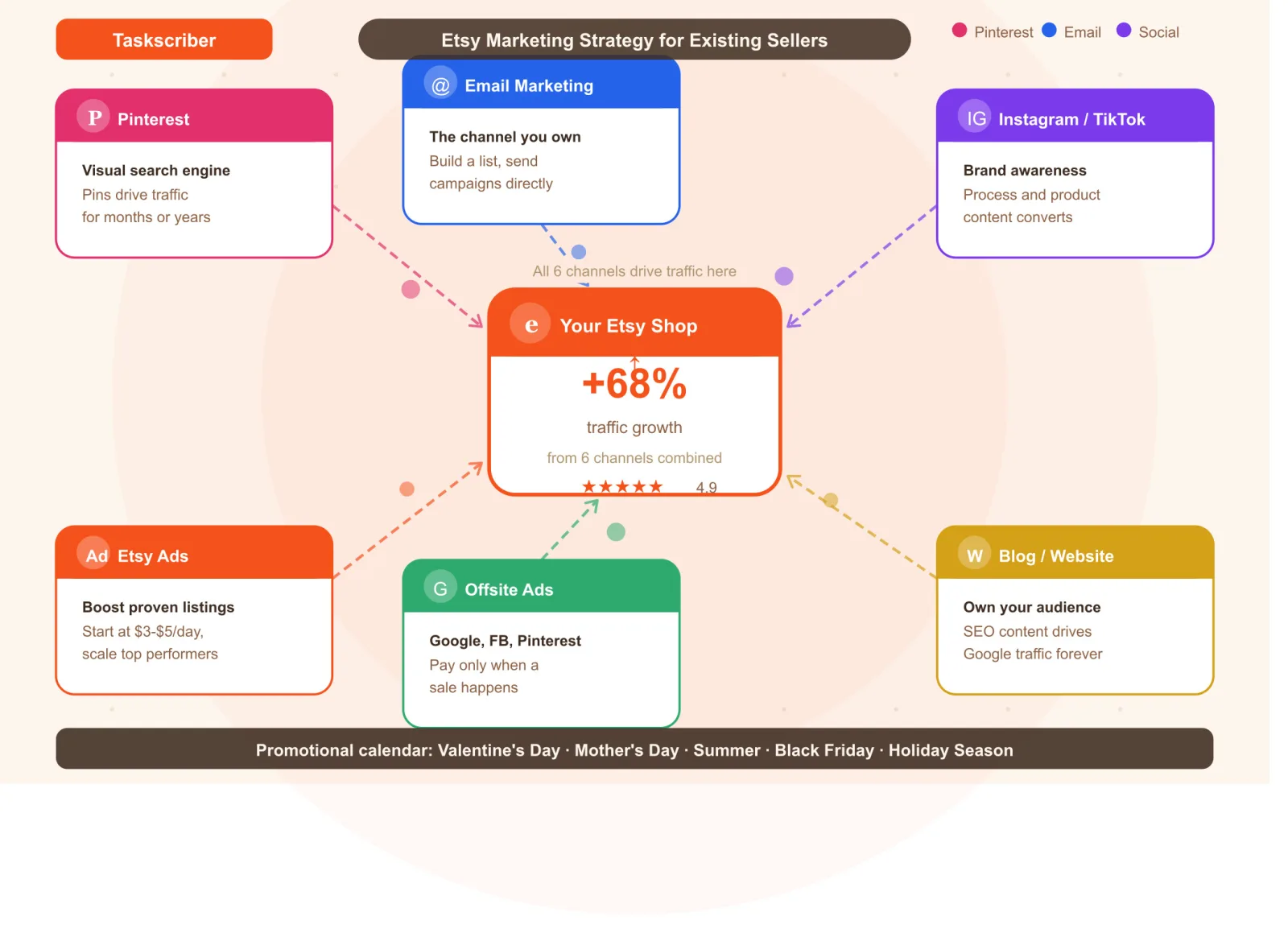
Etsy Marketing Strategy: How Existing Sellers Can Drive More Traffic to Their Listings
An Etsy marketing strategy is not something most sellers think about when they are just starting out. In the beginning, the focus is on getting products listed, figuring out photography, and hoping the first sale comes in.
But once you have an established shop with real listings and real products, the rules of the game change. You are no longer just trying to exist on the platform. You are trying to grow — and growth requires traffic.
The problem most existing Etsy sellers face is not product quality. It is visibility. Their listings are good. Their prices are competitive. Their photos are decent. But views are inconsistent, sales spike and dip with no clear pattern, and there is no predictable way to bring new buyers in.
That is a marketing problem, not a product problem. And it is entirely solvable.
This guide covers the most effective Etsy marketing strategies for existing sellers who want to drive more traffic to their listings consistently — using both on-platform tools and off-platform channels that most sellers are not fully utilizing.
Why Etsy SEO Alone Is Not Enough Anymore
Before getting into marketing tactics, it is worth addressing the most common assumption existing sellers make: that good SEO is all you need.
Etsy SEO is foundational. Getting your titles, tags, and listings optimized correctly is the baseline every seller needs in place before anything else. But relying on Etsy search alone to drive all your traffic is a fragile strategy.
Etsy's algorithm changes. Competition increases every year. New sellers enter your niche constantly. And when Etsy adjusts how it ranks listings — which it does regularly — shops that depend entirely on organic search can see their traffic drop overnight with no warning.
The sellers who build stable, growing income on Etsy are the ones who treat Etsy SEO as one piece of a broader traffic strategy. They drive external traffic from Pinterest, email, and social media. They use Etsy Ads strategically. They build audience relationships that bring buyers back without relying on the algorithm every single time.
That is what a real Etsy marketing strategy looks like.
Channel 1: Pinterest — The Most Underused Traffic Source for Etsy Sellers
If you are an existing Etsy seller and you are not using Pinterest consistently, you are leaving a significant amount of free traffic on the table.
Pinterest is not a social media platform in the traditional sense. It is a visual search engine — and one that is uniquely aligned with exactly what Etsy sellers offer. Handmade products, home decor, gifts, jewelry, clothing, art, and stationery all perform exceptionally well on Pinterest because they are exactly what Pinterest users are searching for and saving.
More importantly, Pinterest content has a long shelf life. A pin you create today can continue driving traffic to your Etsy listings for months or even years. That is fundamentally different from Instagram or Facebook, where content disappears from feeds within hours.
How to use Pinterest effectively as an Etsy seller:
Create a Pinterest business account and claim your Etsy shop. This connects your two platforms so that products pinned from your Etsy listings automatically carry your branding and link back to your shop. Every time someone saves one of your product pins, that save becomes a new entry point for buyers.
Create pin images specifically designed for Pinterest. Vertical images in a 2:3 ratio perform best. Show your product in context — styled in a real setting rather than just on a plain background. Pinterest users respond to imagery that helps them visualize the product in their own life.
Write keyword-rich pin descriptions. Pinterest uses these descriptions to understand what your content is about and surface it in search results. Include the same buyer-focused keywords you use in your Etsy listings — because the people searching on Pinterest and the people searching on Etsy are often the same people.
Pin consistently. You do not need to spend hours on Pinterest every week, but consistency matters more than volume. Using a scheduling tool like Tailwind allows you to batch your pinning in one session and drip content out over time without logging in daily.
Create boards that match buyer intent. Instead of a board called "My Products," create boards called "Unique Birthday Gifts for Her" or "Handmade Home Decor Ideas." These board titles are what Pinterest users search for. Organizing your pins into intent-based boards dramatically increases the chance of them being discovered.
Channel 2: Email Marketing — The One Channel You Actually Own
Most Etsy sellers do not build an email list. This is one of the most costly long-term mistakes a growing shop can make.
Every channel you use to reach buyers — Pinterest, Instagram, Etsy search itself — is a platform you do not own. The algorithm changes. The reach drops. The rules shift. But an email list is yours. No platform can take it away, and no algorithm update can stop your message from reaching the people on it.
Etsy does not allow you to market directly to your past buyers through the platform, but you can build an email list through lead magnets, social media, and your own website or landing page, then use that list to drive traffic back to your Etsy shop whenever you launch a new product, run a promotion, or want to re-engage past buyers.
How to start building and using an email list as an Etsy seller:
Create a simple lead magnet that your ideal buyer would genuinely want. A care guide for your product type, a gift guide featuring your items, a discount code for first-time buyers, or a behind-the-scenes look at your process all work well. Promote this lead magnet through your social media channels and link to a simple signup page.
Include a card in every order that invites buyers to join your list. Keep it simple: "Join our list for early access to new products and exclusive offers." Buyers who loved their purchase are the most motivated subscribers you can get.
Send emails that are actually worth reading. New arrivals, seasonal collections, the story behind a new product, limited-time offers, and customer spotlights all give subscribers a reason to open your emails rather than delete them. Aim for a rhythm of two to four emails per month — consistent but not overwhelming.
Every email should include a direct link to your Etsy shop or to specific listings relevant to what you are sharing. External traffic that results in purchases sends a strong positive signal to Etsy's algorithm and can lift your search rankings alongside generating direct sales.
Channel 3: Instagram and TikTok — Building an Audience Around Your Brand
Social media is not the fastest way to drive Etsy traffic, but it is one of the most powerful for building long-term brand awareness and a loyal customer base that comes back to your shop repeatedly.
The key distinction is that social media works best when you are building an audience around your brand identity — not just promoting products. People follow accounts that entertain, educate, or inspire them. If every post is a product photo with a price tag, follower growth will be slow and engagement will be low.
What works on Instagram for Etsy sellers:
Process content consistently outperforms product-only content. Videos and reels showing how you make your products, behind-the-scenes of your workspace, packing orders, and sourcing materials build genuine connection with an audience that product shots alone never can.
Use Instagram Stories to promote listings directly. Stories allow you to add a link sticker that sends viewers directly to a specific Etsy listing. For shops with engaged followers, this is one of the most direct ways to drive traffic from Instagram to Etsy.
User-generated content is powerful. When customers tag you in photos of your products, reshare that content. It builds social proof, rewards your customers for sharing, and shows potential buyers real people using and loving your products.
What works on TikTok for Etsy sellers:
TikTok's algorithm gives new and small accounts significantly more organic reach than Instagram. A single video from a shop with 200 followers can reach tens of thousands of viewers if the content resonates. That makes TikTok one of the most accessible platforms for Etsy sellers who do not yet have a large following.
Pack videos, process videos, and "shop with me" style content all perform well for Etsy sellers on TikTok. Keep videos short, authentic, and specific. The more niche and genuine the content, the better it tends to perform.
Include your Etsy shop link in your bio and reference it in your videos. "Link in bio to shop" is simple but it works — especially after a video that genuinely shows off the quality and personality of your products.
Channel 4: Etsy Ads — How to Use Them Without Wasting Budget
Etsy Ads is the platform's built-in advertising tool that boosts your listings in search results and across Etsy's network. For existing sellers with proven listings, Etsy Ads can be a highly effective way to accelerate traffic and sales.
The critical word is proven. Running Etsy Ads on listings that do not already convert well from organic traffic is a fast way to spend money without results. Before putting ad budget behind a listing, make sure it has strong photos, a keyword-optimized title and tags, competitive pricing, and at least some review history.
How to run Etsy Ads strategically:
Start with a modest daily budget — between three and five dollars per day — and run ads across all your listings initially. After two to three weeks, review which listings generated clicks and conversions and which ones spent budget without results. Cut the underperformers and concentrate your budget on the listings that are already showing traction.
Monitor your cost per click and your conversion rate together. A listing with a high click-through rate but low conversion rate has a traffic problem that ads cannot fix — the issue is likely in the photos, price, or listing description. A listing with a low click-through rate may need better thumbnail images or a stronger title.
Use Etsy Ads as a complement to organic SEO, not a replacement for it. Listings that already rank well organically and also run ads get maximum visibility — they appear in both the standard search results and the promoted listings positions.
Channel 5: Offsite Ads — Understanding What Etsy Does on Your Behalf
Etsy's Offsite Ads program automatically promotes your listings across Google, Facebook, Instagram, Pinterest, and Bing. If a buyer clicks one of these ads and makes a purchase within 30 days, Etsy charges you an advertising fee of 12 to 15 percent of the order total.
For shops making over $10,000 per year on Etsy, participation in Offsite Ads is mandatory. For smaller shops, it is optional.
The question existing sellers often ask is whether Offsite Ads are worth it. The honest answer is that for most product categories they are, because you only pay when a sale actually happens. There is no upfront cost and no wasted spend on clicks that do not convert. The advertising fee comes out of an order you already made.
The sellers who struggle with Offsite Ads tend to have thin margins that cannot absorb the additional fee without affecting profitability. If your pricing does not account for a potential 15 percent advertising fee on some orders, it is worth reviewing your margins before Offsite Ads become a significant part of your traffic picture.
Channel 6: Your Own Website or Blog — Building Traffic You Control
This is the long-term play that most Etsy sellers never consider, and it is one of the highest-leverage moves a growing shop can make.
A simple website or blog connected to your Etsy shop lets you create content that ranks on Google, builds your brand identity outside of Etsy's marketplace, and gives you a direct relationship with buyers that Etsy's platform structure does not allow.
A blog post titled "15 Unique Handmade Gift Ideas for Coffee Lovers" that ranks on Google and links to your Etsy listings can drive consistent, free traffic for years. A gift guide published before the holiday season that features your products and ranks for seasonal search terms can bring in more sales than a month of Instagram posts.
This approach takes more time to build than the other channels, but the traffic it generates is the most durable and the most predictable over the long run. It is also the only channel through which you can fully own the relationship with your audience — on your domain, with your branding, under no platform's terms of service.
Building a Promotional Calendar for Your Etsy Shop
One of the most effective things an existing Etsy seller can do is stop reacting to seasons and start planning for them. A promotional calendar maps out the key sales opportunities across the year and gives you enough lead time to prepare listings, create content, and build audience anticipation before each peak period.
The major selling seasons for most Etsy categories include Valentine's Day, Mother's Day, graduation season, back to school, Halloween, Thanksgiving, the holiday gifting season from Black Friday through Christmas, and New Year. Depending on your niche, you may also have category-specific moments — wedding season for jewelry and home decor sellers, for example, or summer entertaining for kitchen and outdoor product sellers.
For each peak period, work backward from the date and plan when you will update listings with seasonal keywords, when you will start pinning seasonal content on Pinterest, when you will send email campaigns to your list, and when you will run Etsy Ads promotions.
Sellers who plan this way consistently outperform those who scramble to react at the last minute. They rank for seasonal keywords before the rush starts. Their email campaigns go out when buyers are beginning to research rather than when they are ready to check out. Their Pinterest content has already been circulating for weeks by the time peak buying season hits.
Combining Channels for Maximum Traffic Impact
The sellers who grow most reliably are not the ones who find one marketing channel that works and rely on it exclusively. They are the ones who build multiple traffic streams that reinforce each other.
Here is what a combined Etsy marketing strategy looks like in practice:
Your Etsy listings are fully optimized with the right keywords so they capture organic search traffic from buyers already on the platform. Pinterest drives consistent external traffic from visual search that supplements your Etsy SEO. An email list lets you communicate directly with past buyers and interested prospects without paying for reach. Instagram and TikTok build brand awareness and feed new followers into your ecosystem. Etsy Ads accelerate traffic to your proven best sellers. A seasonal promotional calendar keeps all of these channels working together toward the same peaks rather than operating independently.
No single channel carries the full weight. Each one contributes, and together they create a traffic picture that is far more stable than any single source could provide.
How Automation Makes This Manageable
Reading through all of the above, the natural response is: when am I supposed to do all of this while also running my shop?
That is a fair question, and it is exactly the right one to ask.
The answer is systems and automation. Email sequences can be set up once and run automatically. Pinterest scheduling tools batch your pinning into one session per week. Content batching — creating multiple pieces of social media content in a single sitting — dramatically reduces the daily time commitment. Promotional calendar templates mean you are not reinventing the plan every season.
The sellers who execute this kind of multi-channel Etsy marketing strategy successfully are not spending five hours a day on marketing. They are spending two to three focused hours per week, because they have built systems that run efficiently in the background.
For shop owners who want that infrastructure built properly but do not have the time or expertise to do it themselves, partnering with an operational support team makes the difference between a marketing plan that stays in a document and one that actually runs.