Reinstated in 19 Days — How Taskscriber Rebuilt a Walmart Seller From the Ground Up
The Problem
Pinnacle Supply Co. had spent nearly three years building a Walmart Marketplace business selling sporting goods, outdoor equipment, and fitness accessories.
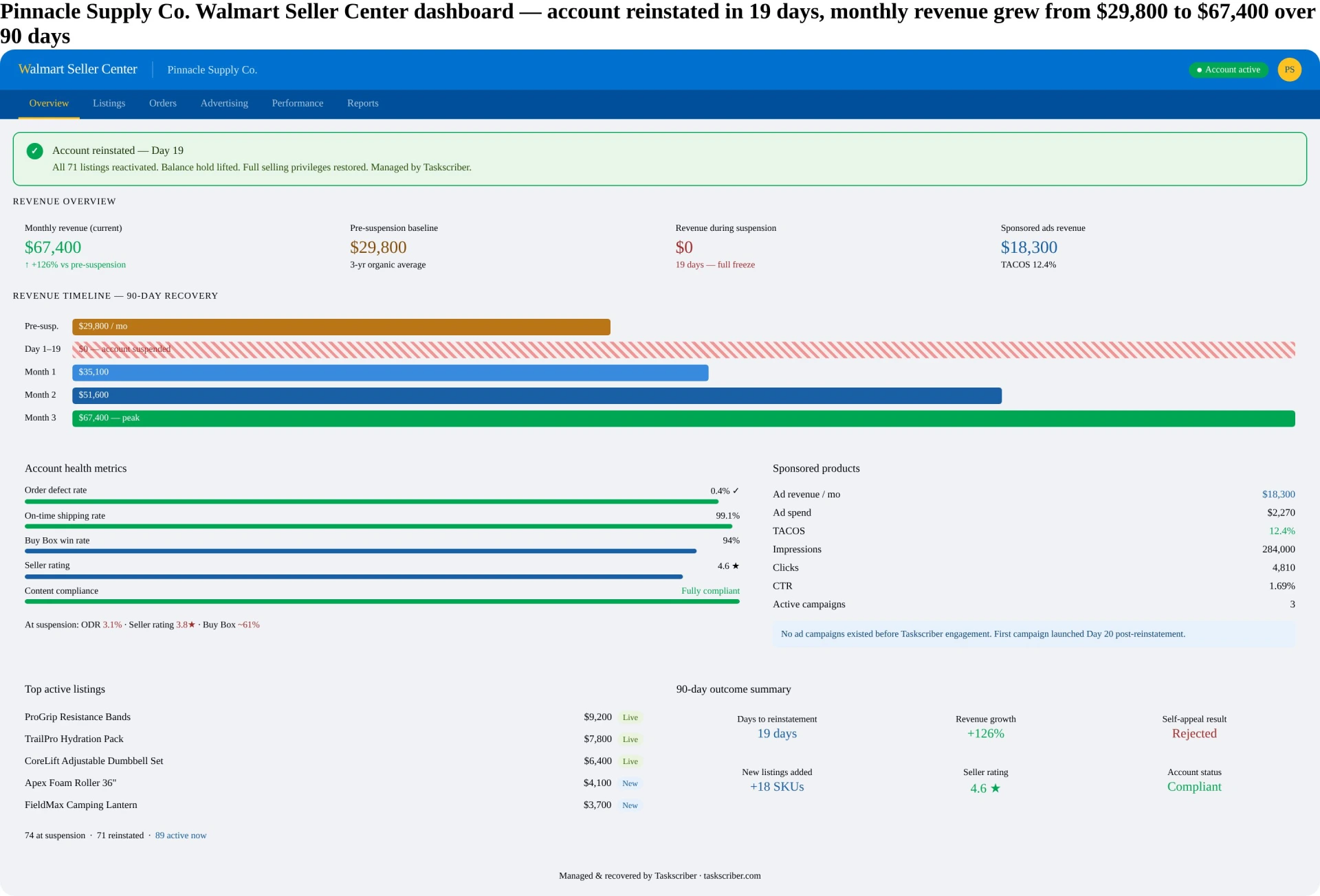
By the time their account was suspended, they were generating $29,800 per month across 74 active listings — not a massive operation, but a real, functioning business that two people depended on full time.
Then, in a single afternoon, it was gone.
The suspension notice arrived without warning. The language was dense, the violation citations were vague, and the seller center offered no clear path forward. The account had been flagged for what Walmart categorized as three separate policy breaches:
Counterfeit and authenticity concerns — Three SKUs in the fitness accessories category had been flagged following a brand registry complaint filed by a competing seller. Pinnacle Supply Co. had sourced these items through a domestic wholesale distributor and had no knowledge the inventory had any authenticity issues. Walmart's automated enforcement system treated the complaint as credible and acted immediately.
Seller performance metric violations — Over a 45-day period, Pinnacle's Order Defect Rate had climbed to 3.1%, exceeding Walmart's 2% threshold. The spike was caused by a fulfillment delay during a warehouse transition, compounding an existing issue with two slow-moving SKUs that had generated a disproportionate share of customer dissatisfaction claims.
Prohibited content in product listings — A routine content audit by Walmart's compliance team had flagged 18 listings for using claims that violated their content standards. Specifically, several product descriptions referenced health outcomes and included comparative superlatives that Walmart's guidelines explicitly prohibit.
The seller had not acted negligently. Most of the violations had escalated quietly in the background, flagged by automated systems before any human review occurred. But in Walmart's enforcement framework, intent carries almost no weight. What matters is the record — and the record showed three active violations across an account that had never received a formal warning.
One self-submitted appeal had already been rejected. Walmart's response was a two-sentence denial referencing their seller policies, with no guidance on what the appeal had failed to address.
Pinnacle Supply Co. came to Taskscriber ten days into the suspension with two problems that felt equally urgent: they needed their account back, and they needed to understand why every single dollar of growth they had built over three years had just been wiped out by a system they didn't fully understand.
There was also a third problem — one they hadn't fully articulated yet, but that became clear during our initial diagnostic. Even before the suspension, the account had significant untapped revenue potential. The business had grown organically, without any structured listing optimization, pricing strategy, or sales generation system. Reinstating the account was necessary. But reinstating it and then returning to the same passive approach would put them right back in the same vulnerable position.
Taskscriber took on both objectives.
Our Solution
The Starting Point
Before building any reinstatement strategy, we needed a complete, honest picture of where the account stood.
Our initial audit covered four areas:
Account health history — We reviewed the full performance timeline going back 18 months. The ODR spike was recent and isolated. Outside of the 45-day problem window, Pinnacle's metrics were consistently solid. On-time shipping had historically exceeded 97%. Cancellation rates were well below threshold. The authenticity complaint was the only brand-related flag on record.
Listing inventory review — We went through all 74 listings individually. The content violations were more widespread than initially reported — we identified 23 listings with some form of non-compliant content, not 18. Several had minor issues that wouldn't have triggered immediate action but would have created ongoing compliance risk.
Supplier documentation — We worked with the seller to pull together all available purchase records, distributor invoices, and supplier communication for the three flagged authenticity SKUs. The documentation confirmed legitimate sourcing through a registered domestic wholesale operation. The brand complaint appeared to have been filed by a competing seller — a pattern Walmart is increasingly aware of but still slow to address through its standard enforcement process.
Sales performance analysis — We looked at revenue distribution across the catalog. The data revealed that 61% of total revenue was coming from just 11 listings. The remaining 63 listings were generating minimal sales — many had never been properly optimized, had thin or missing descriptions, poor imagery, and no structured keyword strategy.
This last finding was important. Pinnacle Supply Co. wasn't just a suspended account waiting to be reinstated. It was an account with a structurally weak foundation that had left most of its earning potential on the table.
The Reinstatement Strategy
Walmart's reinstatement process has one non-negotiable requirement: the Plan of Action must demonstrate that the seller has already resolved the violations, not that they intend to. Sellers who submit appeals promising future corrective action are almost always denied. Sellers who arrive with completed remediation and documented evidence get reviewed seriously.
We structured the reinstatement in three phases.
Phase One — Remediation Before Appeal (Days 1 to 8)
Before a single word of the appeal was written, we completed every corrective action the appeal would reference.
For the authenticity complaints, we compiled a complete supplier documentation package — invoices, distributor records, product authentication certificates, and a formal letter from the wholesale distributor confirming the legitimacy of the sourced inventory. We also voluntarily removed all three flagged SKUs from the catalog pending Walmart's review, demonstrating that the seller was prioritizing compliance over short-term revenue recovery.
For the ODR violation, we obtained and organized shipping records, fulfillment partner correspondence, and warehouse transition documentation that established a clear, verifiable timeline for the metrics spike. We also terminated the underperforming 3PL arrangement and had a new fulfillment partner agreement in place before the appeal was submitted — with written confirmation of their Walmart-compliant SLA commitments.
For the content violations, we rewrote every non-compliant listing from scratch. All 23 flagged listings were rewritten to Walmart's content standards, with prohibited claims removed, health-related language stripped entirely, and comparative superlatives replaced with factual, specification-based descriptions. We also built a content compliance checklist and applied it to the remaining listings in the catalog to prevent any new flags during or after the review process.
Phase Two — Plan of Action Construction (Days 9 to 12)
With remediation complete and fully documented, we wrote the Plan of Action.
Walmart's seller performance team reads hundreds of these documents. The most common failure pattern is an appeal that reads like a defense — where the seller explains why the violations weren't really their fault, minimizes the severity of the issues, or makes vague commitments about future behavior. These are dismissed quickly.
Our approach was the opposite. The appeal acknowledged every violation directly, with no deflection. For each violation category, the document provided a precise root cause analysis, followed by a summary of the corrective actions already completed, followed by a specific, measurable prevention plan with defined protocols and review schedules.
The root cause section was particularly detailed. We explained the authenticity complaint in the context of Walmart's brand protection framework, acknowledged the gaps in Pinnacle's supplier vetting process that had allowed the situation to arise, and documented the specific process changes implemented to prevent recurrence. We were direct about the ODR spike — including the operational decision that caused the warehouse transition — and provided a complete fulfillment partner transition timeline.
The language throughout was professional, specific, and solution-oriented. No emotion. No appeals to the seller's history or loyalty. No requests for special consideration. Just documented facts and completed corrective action.
The document was 2,100 words with seven supporting attachments.
Phase Three — Submission, Monitoring, and Escalation (Days 13 to 19)
The appeal was submitted on Day 13. Walmart's standard review window is 3 to 5 business days.
On Day 17, with no response, we initiated a structured escalation through Walmart's seller support escalation pathway. The escalation referenced the appeal submission date, summarized the corrective actions completed, and requested senior review given the completeness of the remediation package. We attached the appeal documentation directly to the escalation request.
On Day 19, Walmart reinstated the account.
The reinstatement notice confirmed full account restoration, with all remaining listings reactivated and no pending balance holds. The three flagged SKUs remained under review pending brand dispute resolution, but the rest of the catalog — 71 listings — was immediately live.
Post-Reinstatement: Building a Sales Generation System
Reinstatement solved the immediate crisis. But as we had identified during the initial audit, the account had never been built to perform at its actual potential. Going live again with the same passive approach would have recovered maybe $22,000 to $26,000 per month — roughly where the account had been trending before the fulfillment issues began dragging down metrics.
That wasn't good enough. Pinnacle Supply Co. had just spent 19 days with zero revenue and significant stress. They needed a growth trajectory, not a flat recovery.
Over the following 71 days, Taskscriber implemented a complete account growth system across four areas.
Listing Optimization and Catalog Expansion
Every active listing was rebuilt with a structured approach to Walmart's search algorithm, customer intent, and conversion optimization.
Each product title was rewritten to lead with the most specific product attribute Walmart shoppers search for first — category, key specification, brand name, and use case — within Walmart's 75-character limit. Product descriptions were rebuilt around customer outcomes and use cases rather than feature lists, with natural integration of high-intent search terms identified through Walmart's own search data and competitor analysis.
Bullet points were restructured to follow a consistent format: primary benefit first, supporting specification second, use case clarification third. Images were reviewed against Walmart's content standards and flagged for seller-side improvement in cases where lifestyle context or dimension callouts were missing.
Beyond optimization, we identified 31 catalog gaps in the sporting goods and outdoor equipment categories where Pinnacle's existing supplier relationships could support additional SKUs. We prioritized 18 of these based on demand data, competition density, and margin viability, and worked with the seller to source and list them during the growth phase.
Walmart Advertising — Sponsored Products Setup
The account had never run a single paid campaign. This was the single largest missed opportunity we identified.
Walmart's Sponsored Products program operates similarly to Amazon's PPC but with less competition in most categories — particularly in the sporting goods and outdoor equipment space, where many sellers still rely entirely on organic search. This created an immediate opening.
We built out a campaign structure across three tiers. The first tier targeted the top 12 highest-revenue listings with auto campaigns to gather search term data. The second tier used manual campaigns targeting the highest-converting search terms identified from the auto campaign data, with product-specific bids calibrated to the margin profile of each SKU. The third tier ran competitive conquest campaigns targeting the top three competing sellers in Pinnacle's primary subcategories.
Campaign management included weekly bid adjustments, negative keyword harvesting to eliminate wasted spend, and monthly budget reallocation toward the campaigns delivering the strongest return on ad spend.
Pricing and Buy Box Strategy
Pinnacle had been pricing based on gut feel — watching competitors occasionally and adjusting manually when they noticed significant gaps. This approach was leaving margin on the table while also costing them Buy Box position on several high-volume SKUs.
We implemented a structured pricing review. For each of the top 30 revenue-generating listings, we analyzed Walmart's Buy Box ownership pattern, competitive pricing distribution, and the relationship between price and conversion rate in the account's own historical data.
Several listings were actually priced too low — not competitively, but unnecessarily so, suppressing margins without a corresponding benefit to volume. We raised prices on 9 SKUs and saw no meaningful conversion drop.
For the 11 listings where Buy Box ownership was contested, we built a pricing strategy that balanced competitiveness with margin protection — not racing to the bottom, but staying within the competitive band that Walmart's algorithm rewards with Buy Box preference.
Review Generation and Seller Rating Improvement
At the point of reinstatement, Pinnacle's seller rating had dropped to 3.8 stars as a result of the fulfillment period issues. Several products had accumulated negative reviews during the ODR spike that were suppressing conversion rates on otherwise strong listings.
We built a post-purchase follow-up system using Walmart's approved seller messaging tools. Every completed order triggered a two-stage communication sequence — a shipping confirmation with useful product information, followed by a post-delivery message encouraging the customer to share their experience. The messaging was brand-appropriate, genuinely helpful, and fully compliant with Walmart's seller communication guidelines.
We also worked through Walmart's dispute process to address the most impactful negative reviews — specifically those that reflected the fulfillment issues rather than genuine product dissatisfaction. Where Walmart's guidelines permitted, these were flagged for review.
Within 60 days, the seller rating had recovered to 4.6 stars.
"We came to Taskscriber because our account was suspended and we were out of options. What we didn't expect was that they would actually rebuild the entire business while they were at it. The reinstatement was fast and professional — but the real impact was what happened after. We went from scrambling to survive to having our best quarter ever. The systems they put in place are still running and the account keeps growing."
Results
89
Active Listings
4.6 ★
Seller Rating
0.4%
Order Defect Rate
99.1%
On-Time Shipping
94%
Buy Box Win Rate
19 days
Days to Reinstatement
Quick Facts
- Client Pinnacle Supply Co.
- Industry E-Commerce / Sporting Goods & Outdoor
- Published Jun 2026
More Case Studies

Meridian Dental Group
214 new patients booked in the first quarter after launch.

ClearRoute Logistics
Inbound enterprise enquiries tripled after a full website overhaul.

Ember & Oak Restaurant Group
Online reservations up 240% and a full events calendar every weekend.