Most small business owners have tried Facebook marketing at some point. They boosted a post, spent $50, got a handful of likes, and decided it doesn't work.
It works. They just didn't have the right system behind it.
Facebook is still one of the most powerful platforms for reaching your ideal customers and generating consistent leads. Over 200 million businesses use Facebook Pages. But the ones actually converting that attention into revenue aren't the ones posting the most. They're the ones with a proper funnel behind every ad.
This article breaks down exactly how to build a Facebook marketing strategy that generates real pipeline, not vanity metrics. Whether you're spending $300 a month or $3,000, the principles are the same. And once you understand them, you'll stop guessing and start building.
Why Most Small Business Facebook Marketing Falls Flat
Before we get into strategy, it's worth understanding why so many businesses waste money on Facebook.
The most common mistake is treating Facebook like a billboard. You create a post, boost it to a broad audience, and hope people call you. That approach almost never works, for a few reasons.
First, Facebook users aren't searching for your service. Unlike Google, where someone actively types "accountant near me," Facebook users are scrolling through photos of their friends' kids. Interrupting them with a pitch requires a different approach.
Second, most businesses send cold traffic directly to their homepage. A homepage is not a landing page. It has too many options, too little focus, and no clear next step for someone who just discovered you thirty seconds ago.
Third, there's no follow-up system. Someone clicks the ad, looks around, doesn't buy, and disappears. Without retargeting and email automation, that lead is gone.
The solution isn't to spend more. It's to build the right infrastructure behind your ads.
The Facebook Marketing Framework That Actually Works
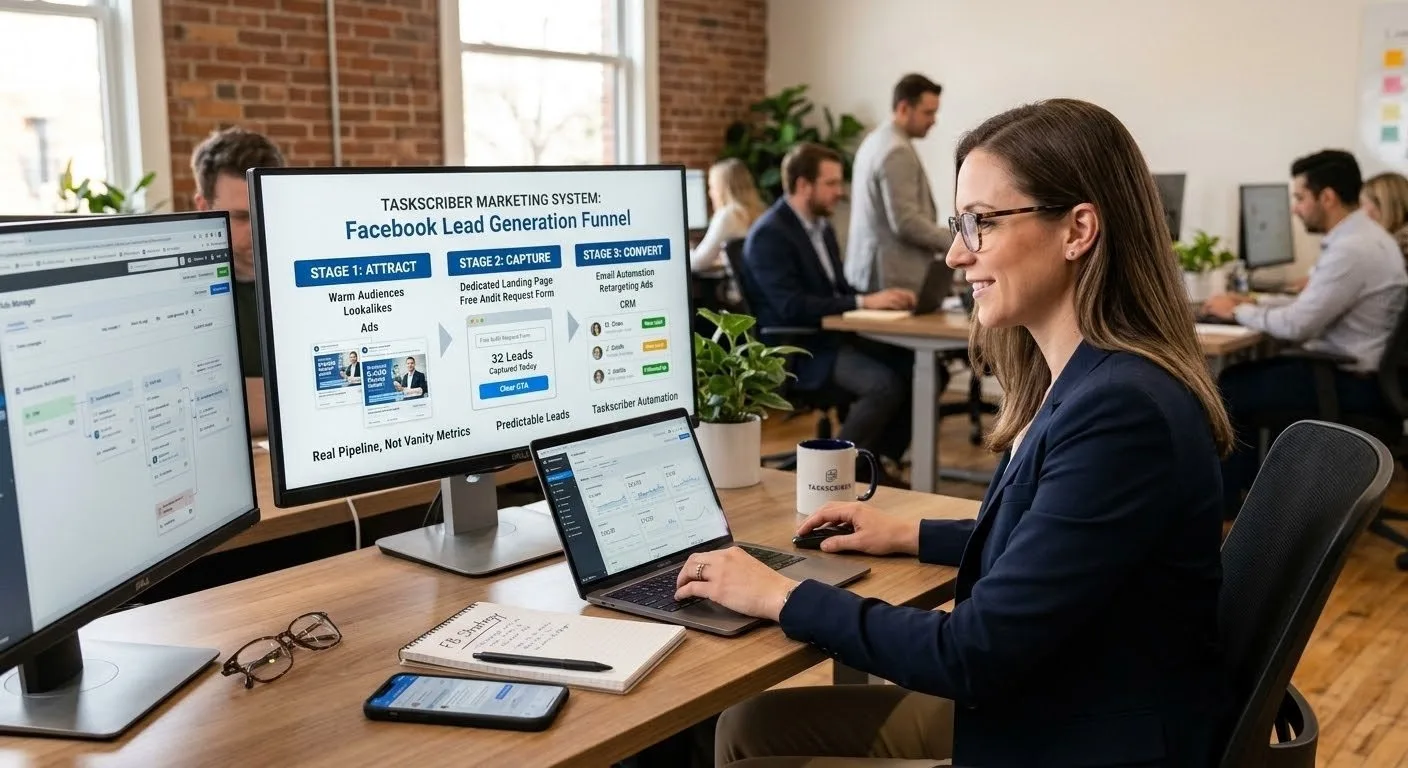
Think of Facebook marketing as a three-stage system: attract, capture, and convert. Every piece has to work together. If one stage breaks, the whole thing fails.
Stage 1: Attract the Right People
Facebook's targeting is genuinely powerful when you use it correctly. The goal at this stage is to reach people who match your ideal customer profile, not just people who are vaguely in your industry.
Start with your warm audiences. These are people who already know you in some way. Your website visitors, your email list, your video viewers, people who've engaged with your Page. Facebook lets you upload your customer list and build what's called a Custom Audience. These people are far more likely to respond to your ads because they've already had some exposure to your brand.
Then build Lookalike Audiences. Once you have a Custom Audience, you can ask Facebook to find other users who look statistically similar to your best customers. This is where Facebook's data becomes genuinely useful. You're not guessing anymore. You're scaling what already works.
Get specific with interest targeting. If you don't have a large customer list yet, interest targeting lets you reach people based on what they follow, what they engage with, and what they've indicated they care about. Layer in behaviors and demographics to tighten the audience further.
The goal is relevance, not reach. A smaller, well-targeted audience will always outperform a massive but generic one.
Stage 2: Capture the Lead
Once someone clicks your ad, you have about eight seconds to hold their attention. Where you send them matters more than most people realize.
Use a dedicated landing page, not your homepage. A landing page has one job: get the visitor to take a single action. That might be filling out a form, booking a call, or claiming a lead magnet. Remove the navigation menu, cut the distractions, and make the value proposition impossible to miss.
Lead forms work well for local and service businesses. Facebook has a native lead form feature that lets people submit their information without leaving the platform. Conversion rates tend to be higher because there's no extra click, no page to load. The downside is that lead quality can be lower, so the follow-up process has to be tighter.
Use a lead magnet if you're in a longer sales cycle. Offering something valuable in exchange for an email address, whether that's a guide, a checklist, a free audit, or a short training, builds trust before you ask for the sale. This works especially well for professional services, coaching, consulting, and B2B businesses.
Whatever you choose, the key is that your landing page matches the ad. If your ad promises a free quote, the page better lead with that offer immediately. Any disconnect kills conversions.
Stage 3: Convert Through Automation
This is where most small businesses drop the ball completely, and it's also where the biggest opportunity lives.
When someone fills out your form or opts into your lead magnet, what happens next? If the answer is "someone manually checks a spreadsheet and eventually emails them," you're losing leads every single day.
A proper Facebook marketing system triggers an automated sequence the moment a lead comes in.
The follow-up email goes out within minutes, not hours. The lead gets tagged in your CRM based on which ad they responded to. An automated nurture sequence begins that educates, builds trust, and moves the prospect toward a buying decision. If they don't take the next step within a few days, a follow-up sequence re-engages them.
Meanwhile, they're seeing retargeting ads on Facebook that reinforce the message, show social proof, and keep your business top of mind.
This combination, email automation plus retargeting, is what separates businesses that generate consistent leads from those that get random results.
Setting Up Facebook Retargeting the Right Way
Retargeting is one of the most cost-effective advertising strategies available. You're showing ads to people who already know who you are. The trust barrier is lower. The conversion rates are higher.
Here's how to structure a simple retargeting system:
Website Visitors (Last 30 Days) — People who visited your site but didn't convert. Show them an ad with a stronger offer, a testimonial, or a case study. Remind them why they came in the first place.
Video Viewers (25–75% watch time) — If you run video ads or post educational content, people who watched a meaningful portion of it are warm leads. Retarget them with a direct offer.
Lead Form Openers Who Didn't Submit — Facebook lets you retarget people who opened your lead form but didn't complete it. These are high-intent prospects who got interrupted. A simple follow-up ad can recover a surprising percentage of them.
Email List Retargeting — Upload your existing email list to create a Custom Audience. Show them ads that align with wherever they are in your funnel.
The goal of retargeting isn't to be annoying. It's to stay relevant. When someone sees your ad, reads an email from you, and then sees another ad that adds value, you build familiarity. And familiarity builds trust. And trust is what closes deals.
The Content That Actually Performs on Facebook
Outside of paid ads, organic content still plays a role. But the content that works today is different from what worked five years ago.
Educational content that solves real problems. Short posts that answer a specific question your target customer is already asking. Not promotional. Not vague inspiration. Practical, useful, specific.
Social proof and results. Client wins, before and after stories, case studies shared in a human way. People trust other people more than they trust brands. Show them that real businesses have gotten real results working with you.
Behind-the-scenes content. Let people see how your business actually works. This builds personality and trust in a way that polished marketing content never can.
Video. Facebook still gives more organic reach to video than static posts. It doesn't need to be produced. A quick two-minute breakdown of a concept your audience cares about will outperform a designed graphic most of the time.
One important note: don't make organic content your primary lead generation strategy. Use it to support your paid campaigns, build authority, and warm up audiences. The consistent, predictable leads come from a structured ad system, not from hoping a post goes viral.
What a Full Facebook Marketing System Looks Like
Putting it all together, here's what a complete Facebook marketing system looks like for a small business:
You run a lead generation campaign targeting a Custom Audience built from your best existing customers, plus a Lookalike Audience built from that same group. The ads drive traffic to a focused landing page with a single clear offer.
The moment someone submits, they're added to your CRM automatically with the appropriate tags and pipeline stage. An email sequence kicks off within minutes. A retargeting campaign shows them supporting content, testimonials, and a follow-up offer for the next two weeks.
Your sales team only touches leads who have been nurtured, educated, and have shown clear buying intent. No cold calls to people who barely remember filling out a form.
Every week, you review the data. Which ad had the best cost per lead? Which landing page converted better? Which audience responded the most? You make small adjustments and improve the system over time.
This is not complicated to run once it's built. But it has to be built properly from the start.
The Bottom Line
Facebook marketing works when it's treated as a system, not a series of random posts and boosted promotions. The businesses that consistently generate leads from Facebook are the ones that have the full picture in place: precise targeting, a focused landing page, automated follow-up, and a retargeting strategy that keeps warm leads moving through the funnel.
Getting all of that running correctly takes real expertise. And maintaining it while also running a business is where most owners run out of time.
That's exactly the kind of system Taskscriber builds. From Facebook ad strategy and landing page creation to CRM integration and full marketing automation, we set up the infrastructure that generates qualified leads without requiring you to manage every moving piece yourself.
If you want to stop guessing and start building a predictable lead pipeline, book a free strategy call with our team. We'll audit your current setup and put together a growth plan built around your actual business goals.